
The Short Answer
Your garage door is almost certainly the weakest point in your home's exterior, and it's worth a real inspection before the winter storm season gets going. A door that isn't properly braced, tracked, and sealed can buckle or blow inward under wind pressure, and once that happens, wind gets into the garage and pushes up on the roof from underneath. Spending an hour checking hardware and weatherstripping now is cheaper and easier than dealing with a bowed door, a torn-off section, or interior water damage once a storm has already moved through.
Why the Garage Door Is the Weakest Wall
Every other wall in your house is a continuous, fastened structure. Your garage door is a large moving panel held in place by tracks, rollers, and a handful of hinges, with most of its surface area unsupported in the middle. When wind hits the front of a house, that door takes the brunt of the pressure across the biggest single opening in the building envelope. If the track bends, a roller pops out, or the panel flexes too far, the door can fail completely, and once it's gone, wind pressure inside the garage has nowhere to go but up into the attic and roof structure.
This matters more in homes that have had seismic retrofits, since bracing and shear reinforcement is often focused on walls and foundations, not the garage opening itself. A structurally sound house can still have a garage door that's never been upgraded past what came with the original build.
What Changes This Time of Year
Santa Clara spends most of the summer and early fall dry, which means dust, pollen, and sometimes wildfire smoke settle into garage door tracks, rollers, and weatherstripping over several months with little rain to wash any of it away. When the first real storms arrive, that accumulated grit mixes with moisture and turns into grime that binds up rollers and accelerates rust on springs and hinges. A door that was just sluggish in September can start grinding, sticking, or reversing unexpectedly once the rain starts, right when you need it to seal tightly and operate reliably.
Signs Your Door Isn't Ready for Wind and Rain
- Gaps along the sides or top: Daylight visible around the edges means wind-driven rain and gusts can get through, and weatherstripping has likely hardened or cracked from months of dry heat.
- Loose or rattling hardware: Hinges, track brackets, or roller brackets that have worked loose won't hold up under repeated wind pressure.
- Visible rust on springs or tracks: Even light surface rust from last winter's rain is a sign moisture is getting in and weakening metal components.
- A door that sags or looks slightly bowed: This usually means internal bracing (the horizontal strut across the top section) is missing, bent, or undersized for the door's width.
- Opener struggles to close fully: If the door reverses on its own or won't seat against the weatherstripping, the safety sensors, track alignment, or spring tension may be off, and wind will exploit that gap.
Steps to Take Before the Next Storm
- Inspect and replace weatherstripping. The bottom seal and side seals are the first line of defense against wind-driven rain. If they're cracked, flattened, or torn, water and wind will find a way in.
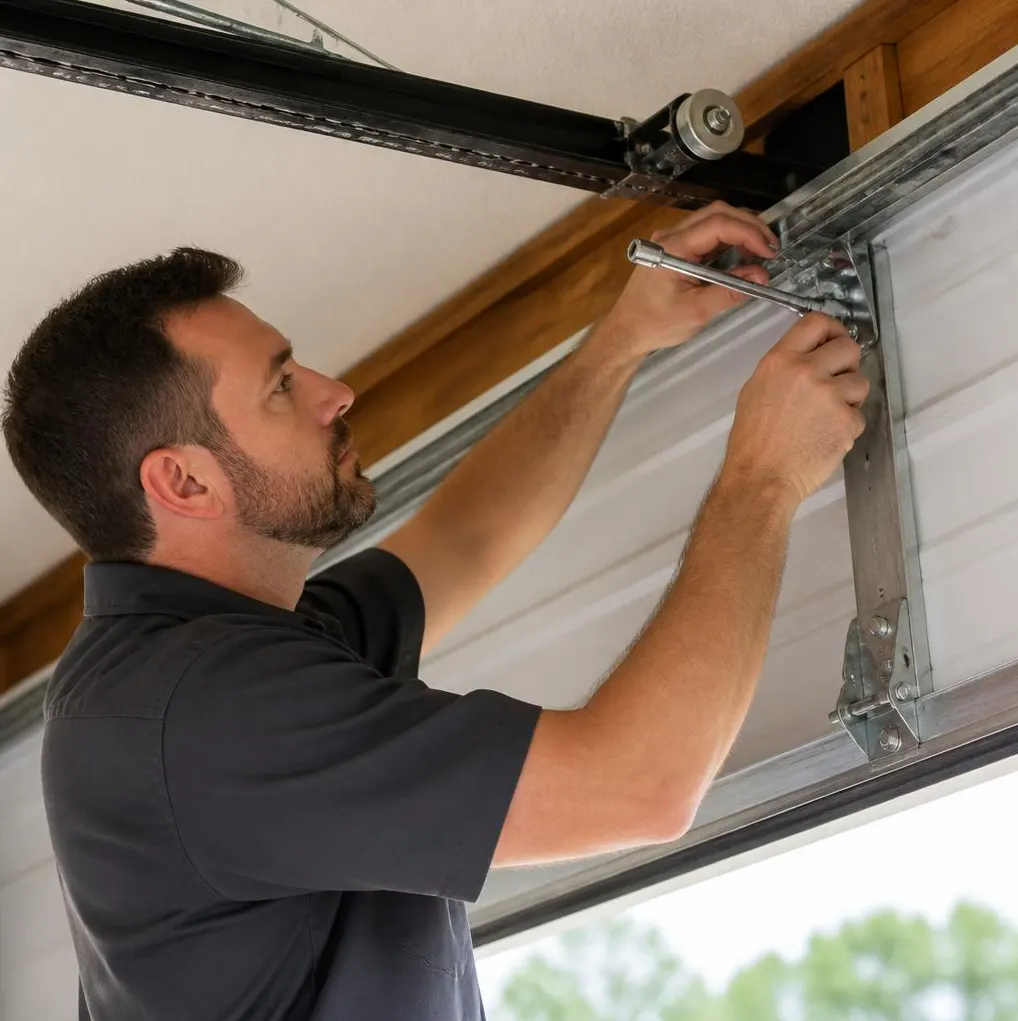
- Tighten all hardware. Go panel by panel and check hinge bolts, track brackets, and roller brackets. Vibration from months of regular use loosens these gradually, and it's easy to miss until something fails under load.
- Check for a horizontal strut. Wider doors, especially two-car doors, need a horizontal reinforcement bar across the top panel to resist wind load. If yours doesn't have one, it's worth adding before storm season rather than after a close call.
- Clear and lubricate the tracks. Remove the dust and debris that built up over the dry months, then apply a garage-door-specific lubricant to rollers and hinges so they move freely instead of binding under pressure.
- Test the auto-reverse safety feature. Place a block of wood in the door's path and make sure it reverses on contact. This isn't just a safety check, it's a sign the opener and sensors are calibrated correctly for reliable operation.
- Consider a battery backup for the opener. Winter storms in this area can bring power outages along with wind, and a battery backup means you're not stuck with a door you can't open or close by remote.
- Walk the perimeter for drainage issues. Make sure gutters and ground slope direct water away from the garage slab. Standing water at the base of the door is what eventually causes bottom panel rot and rust at the track anchors.
When to Call Santa Clara Garage Door Works
If you've gone through this checklist and found rust on the springs, a bowed panel, or hardware that's beyond a simple tightening, it's time to bring in a professional rather than push a storm-damaged door through another season. Our Garage Door Maintenance service covers a full inspection of tracks, rollers, springs, and weatherstripping, with adjustments made on the spot so everything is sealed and balanced before the rain picks up. If we find a spring under too much strain or close to failure, we handle Spring Replacement the same visit, since a spring that fails during a storm can leave a heavy door stuck in whatever position it was in when it broke.
If your current door shows real structural weakness, bowing, or missing reinforcement that can't be fixed with hardware adjustments, we'll talk through installation options built for wind resistance rather than just patching what's there.
Don't wait for the first big storm to find out your garage door isn't ready. Call Santa Clara Garage Door Works today to schedule an inspection before the winter rain and wind move into Santa Clara, CA.